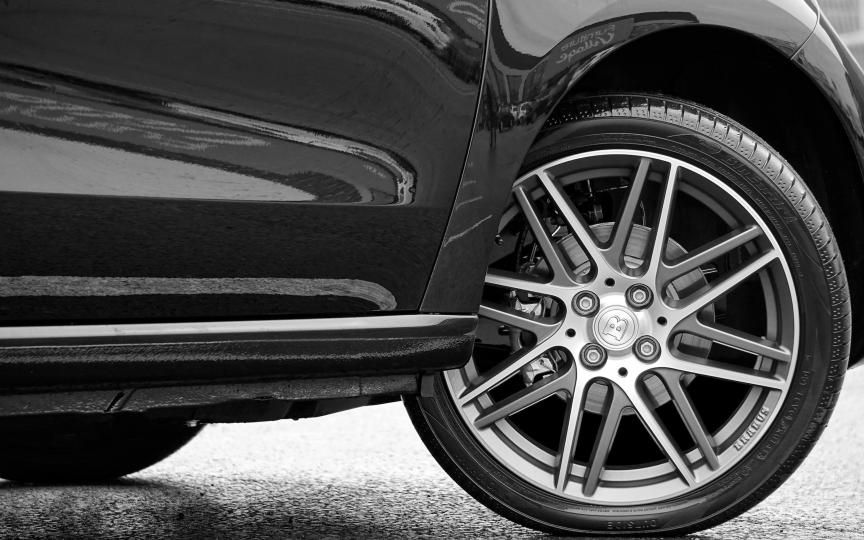
How to read a tire size
A size such as 205/55 R16 91V on the sidewall means:
- 205: section width in millimetres, sidewall to sidewall.
- 55: aspect ratio. The sidewall height is 55% of the width.
- R: radial construction. A dash, as in motorcycle size 90/90-14, usually means bias-ply.
- 16: rim diameter in inches.
- 91V: load index and speed rating (see below). These do not affect the dimensions.
The formulas
Sidewall height = width × aspect ratio ÷ 100
Overall diameter = rim × 25.4 + 2 × sidewall height
Circumference = π × diameter
Revolutions per km = 1,000,000 ÷ circumference (mm)
For 205/55R16: sidewall = 205 × 0.55 = 112.75 mm. Diameter = 16 × 25.4 + 2 × 112.75 = 406.4 + 225.5 = 631.9 mm (24.88 in). Circumference = π × 631.9 ≈ 1,985.2 mm, so the tire turns about 503.7 times per km (810.7 per mile).
These are nominal sizes. A real tire's diameter varies slightly by brand and model, shrinks a few millimetres under load, and loses up to about 15 mm as the tread wears.
Comparing sizes and the speedometer
Your speedometer counts wheel revolutions, so a larger tire makes it read low and a smaller one makes it read high. Changing from 205/55R16 to 225/45R17 (diameter 634.3 mm) is a +0.38% difference: when the speedometer shows 100, you are actually doing about 100.4.
| From 205/55R16 (631.9 mm) to | Diameter | Difference | True speed at indicated 100 |
|---|---|---|---|
| 195/65R15 | 634.5 mm | +0.41% | 100.4 |
| 225/45R17 | 634.3 mm | +0.38% | 100.4 |
| 225/40R18 | 637.2 mm | +0.84% | 100.8 |
| 205/60R16 | 652.4 mm | +3.24% | 103.2 |
| 215/55R17 | 668.3 mm | +5.76% | 105.8 |
A common guideline is to keep the overall diameter within ±3% of the original. Larger changes can affect speedometer accuracy, ABS and traction-control calibration, gearing, and clearance to the body or suspension. Always check the sizes approved for your vehicle (door-jamb placard or owner's manual) and local rules before changing.
Off-road example: going from 265/70R17 (802.8 mm) to 285/70R17 (830.8 mm) is +3.49%, so at an indicated 100 the vehicle is doing about 103.5.
Motorcycle and scooter tires
The same maths applies. A scooter tire 90/90-14 has a sidewall of 81 mm and a diameter of about 517.6 mm (1,626 mm circumference, 615 revolutions per km). A 100/80-17 motorcycle tire is about 591.8 mm across. Older inch sizes such as 3.50-10 use a different system: roughly 3.5 inches of width and height on a 10-inch rim.
Load index and speed rating
| Load index | Max load per tire | Speed rating | Max speed |
|---|---|---|---|
| 88 | 560 kg | T | 190 km/h (118 mph) |
| 91 | 615 kg | H | 210 km/h (130 mph) |
| 94 | 670 kg | V | 240 km/h (149 mph) |
| 100 | 800 kg | W | 270 km/h (168 mph) |
A replacement tire should have at least the load index and speed rating specified for your vehicle.
Common mistakes
- Comparing width only. A wider tire with a lower aspect ratio can have almost the same diameter, while the same width with a higher aspect ratio can be several percent larger.
- Mixing up width and aspect ratio when typing: 55/205 is not a valid size.
- Ignoring the age of the tire. The DOT code ends in four digits for the week and year of manufacture; "2324" means week 23 of 2024.
Effect on the odometer and fuel economy
The odometer uses the same wheel signal as the speedometer, so it is off by the same percentage. With tires 3.24% larger in diameter, an odometer showing 15,000 km means the car has really travelled about 15,486 km. Fuel economy worked out from the odometer will look about 3% worse than it really is, and service intervals based on distance will come slightly late.
To correct a fuel-economy figure, multiply the distance by (new diameter ÷ old diameter) before dividing by the fuel used, or enter the corrected distance in the fuel economy calculator.
Wider tires and handling
A "plus-one" change, such as 205/55R16 to 225/45R17, keeps the diameter almost identical while giving a wider contact patch and a shorter, stiffer sidewall. That usually sharpens steering response, but the ride becomes firmer, the tires are more expensive, and the wheels are more exposed to pothole damage. Narrower, taller sidewalls are often preferred for winter tires and rough roads.
Whatever the size, use the tire pressures given on the vehicle placard, check them monthly when the tires are cold, and fit tires in pairs or full sets on the same axle.
Frequently asked questions
What is the diameter of a 205/55R16 tire?
About 631.9 mm (24.88 inches): a 16-inch rim (406.4 mm) plus two sidewalls of 112.75 mm each.
How much can tire diameter change safely?
A common guideline is within ±3% of the original diameter, and always within the sizes approved for your vehicle.
Do bigger tires make the speedometer read low?
Yes. A tire 3.24% larger in diameter means that at an indicated 100 you are really doing about 103.2.
Can I use 225/45R17 instead of 205/55R16?
Dimensionally they are within 0.4% of each other, which is why this is a common plus-one upgrade, but it needs 17-inch wheels and should be on the vehicle's approved list.
Do bigger tires affect the odometer?
Yes, by the same percentage as the speedometer. With tires 3.24% larger, 15,000 km on the odometer is really about 15,486 km.
Sources
- European Tyre and Rim Technical Organisation (ETRTO), Standards Manual: tyre size designation, load index and speed symbols.
- U.S. National Highway Traffic Safety Administration (NHTSA), Tires: understanding the sidewall and the DOT tire identification number.
Last reviewed 6 October 2026. Results are estimates; see our disclaimer.