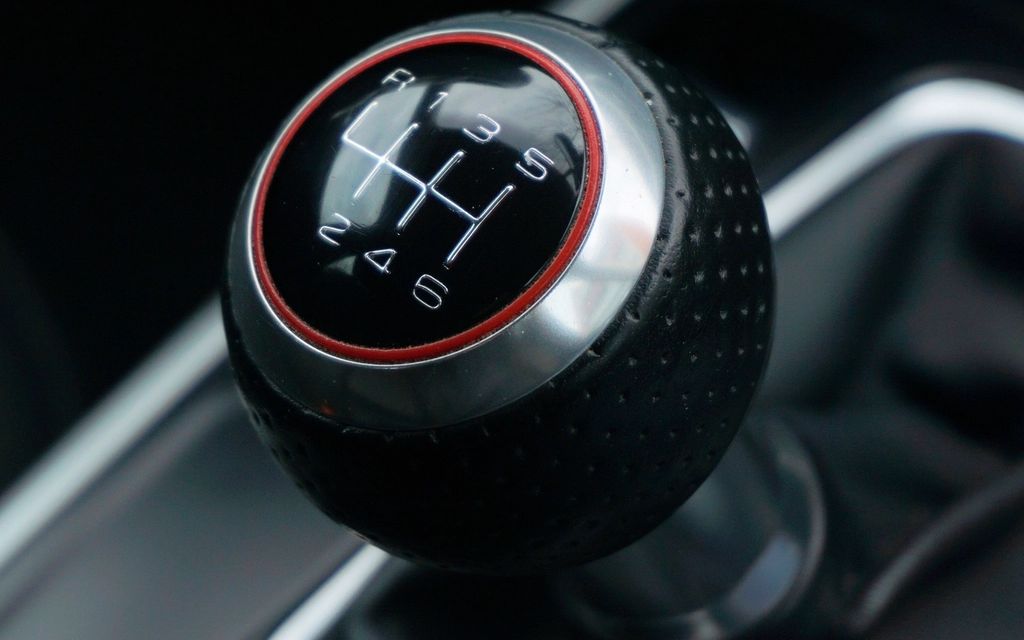
How gearing turns rpm into speed
The engine's crankshaft turns much faster than the wheels. The gearbox ratio and the final drive ratio together set how many engine revolutions it takes to turn the wheel once. Multiply them to get the overall ratio: with a 0.84 top gear and a 4.07 final drive, the engine turns 0.84 × 4.07 ≈ 3.42 times for every wheel revolution. Each wheel revolution moves the vehicle forward by the tyre's circumference.
Tyre diameter (mm) = rim (in) × 25.4 + 2 × width × aspect ÷ 100
Speed (km/h) = rpm × π × diameter (mm) × 60 ÷ (gear ratio × final drive × 1,000,000)
Worked example: a five-speed hatchback
A 205/55 R16 tyre has a diameter of 16 × 25.4 + 2 × 205 × 0.55 = 631.9 mm and a circumference of about 1,985 mm. With the default ratios above and a 4.07 final drive:
| Gear | Ratio | At 3,000 rpm | At 6,000 rpm | rpm after upshift from 6,000 |
|---|---|---|---|---|
| 1 | 3.36 | 26.1 km/h | 52.3 km/h | – |
| 2 | 1.95 | 45.0 km/h | 90.0 km/h | 3,482 |
| 3 | 1.30 | 67.5 km/h | 135.1 km/h | 4,000 |
| 4 | 1.03 | 85.2 km/h | 170.5 km/h | 4,754 |
| 5 | 0.84 | 104.5 km/h | 209.0 km/h | 4,893 |
In top gear this car turns about 2,000 rpm at 70 km/h and 2,500 rpm at 87 km/h. The speeds at 6,000 rpm are what the gearing allows, not what the engine can actually reach; in the higher gears, air resistance and available power set the real top speed.
Reading the rpm drop
When you shift up, engine speed falls in proportion to the two ratios: new rpm = shift rpm × next ratio ÷ current ratio. In the example, shifting from first to second at 6,000 rpm drops to about 3,480 rpm, while shifting from fourth to fifth drops only to about 4,890. Close ratios keep the engine near its strongest rpm range, which is why sporty gearboxes have small steps, while economy gearboxes use a tall top gear for quiet, low-rpm cruising.
What changes when you modify the gearing or tyres
- Shorter final drive (a higher number) gives quicker acceleration and higher rpm at the same speed. Changing the final drive from 4.07 to 3.70 in the example raises top-gear speed at 3,000 rpm from 104.5 to 115.0 km/h, about 10% taller.
- Larger tyres raise speed per rpm in every gear by the same percentage as the diameter grows, and make the speedometer read low. A 225/45 R17 tyre is 634.3 mm tall, only 0.4% more than 205/55 R16, so it barely changes the gearing. Compare sizes with the tyre size calculator.
- Motorcycle sprockets act as the final drive: rear teeth ÷ front teeth. One tooth less at the front shortens the gearing far more than one tooth more at the rear.
Scooters and two-strokes
Many scooters and small motorcycles list overall ratios per gear (engine to wheel) rather than separate gearbox and final drive ratios. In that case enter the overall ratios and set the final drive to 1. A classic scooter tyre such as 3.50-10 is about 3.5 inches (89 mm) wide with a profile roughly as tall as it is wide, so enter width 89, aspect 100 and rim 10, which gives a diameter of about 432 mm. Check the ratios in your service manual, because they differ between models and gearbox versions.
Why the speedometer disagrees
The calculation gives the theoretical speed with a perfectly round tyre. Under load, a tyre squashes slightly, so its effective rolling radius is a little smaller and the real speed is usually a few percent lower than calculated. Tyre wear reduces the diameter further. Speedometers are also allowed to over-read; in the EU and many other countries they must never show less than the true speed. A GPS app is the easiest way to check real speed.
Common mistakes
- Forgetting the final drive, which makes every speed several times too high.
- Using overall ratios and a final drive together, which counts the final drive twice.
- Reading the aspect ratio as millimetres. In 205/55 R16 the 55 is a percentage of the width.
- Expecting the 6,000 rpm top-gear figure to be the vehicle's top speed. It is only what the gearing would allow.
Frequently asked questions
How do I calculate speed from rpm and gear ratio?
Speed (km/h) = rpm × tyre circumference in metres × 60 ÷ (gear ratio × final drive × 1000). The calculator works out the circumference from the tyre size.
What is a final drive ratio?
The fixed reduction between the gearbox output and the wheels, in the differential or, on a chain-drive motorcycle, the sprockets (rear teeth ÷ front teeth).
Does a bigger tyre change my speed?
Yes. Speed at a given rpm rises by the same percentage as the tyre diameter, and the speedometer will read lower than the true speed.
What rpm will I be at after shifting up?
Multiply the shift rpm by the next gear's ratio and divide by the current gear's ratio, for example 6,000 × 1.95 ÷ 3.36 ≈ 3,480 rpm.
Sources
- ETRTO / ISO 4000-1, Passenger car tyre size designation (width, aspect ratio, rim diameter).
- UNECE Regulation No. 39, Speedometer and odometer equipment (indicated speed must not be lower than true speed).
- Gillespie TD. Fundamentals of Vehicle Dynamics, SAE International (gearing and tractive performance).
Last reviewed 7 October 2026. Results are estimates; see our disclaimer.